


Core Summary: For technical teams managing cross-border e-commerce, DTC e-commerce site, and global social media matrices, IP quality directly dictates the survival of your digital assets. This article breaks down the fundamental architectural differences between Residential IPs and Hosting IPs, revealing the risk-control algorithms used by giants like Amazon and TikTok. Whether you’re building a highly anonymous overseas operational environment or preventing “chain-reaction” account bans, mastering the selection of clean Residential ISP nodes is the definitive geek-approved path to secure, compliant, and fully autonomous business operations in 2026.
Why Do Your Cross-Border E-commerce Accounts Keep Getting “Chain-Banned”?
In 2026, the risk-control mechanisms of major cross-border e-commerce platforms (Amazon, eBay, TikTok Shop, Etsy) and payment gateways (PayPal, Stripe) have fully integrated AI and machine learning. New sellers frequently face a frustrating scenario: despite using a pristine device environment and registering with a legitimate business license, their accounts are instantly locked or flagged for rigorous secondary verification the moment registration completes.
The root cause almost always lies in the foundational infrastructure: your network IP. Many beginners, aiming to cut costs, routinely purchase cheap $5/month VPS instances from major cloud providers (AWS, DigitalOcean, Vultr) to set up remote work nodes. However, the IPs assigned to these machines stand out like searchlights in the dark against sophisticated platform Risk Control Strategies. AI algorithms can instantly determine: “A legitimate buyer or local merchant would never be operating from a data center server rack.”
To solve this, we must understand the underlying classification logic of global IP databases.
Under the Hood: The Inherent Flaws of Datacenter IPs
The VPS instances purchased from major cloud providers almost exclusively default to datacenter IPs. In authoritative international IP databases (like MaxMind or IP2Location), their attributes are explicitly classified as Datacenter IP or Hosting IP.
1. Commercial Signatures and ASN Identification
Every IP address belongs to a specific Autonomous System Number (ASN). Datacenter IPs are typically registered under cloud infrastructure companies (e.g., Amazon.com Services LLC, AS16509). When your storefront traffic reaches an e-commerce gateway with this source IP, the firewall instantly queries IP geolocation databases and flags it as a commercial “Hosting” entity, not a residential broadband connection.
2. High Fraud Scores
Why do platforms despise datacenter IPs? They are cheap to acquire and highly automated. Industry security reports consistently show that the vast majority of malicious network activity—malicious scraping, port scanning, spam campaigns, and DDoS attacks—originates from these ranges, prompting strict platform scrutiny. If you’re unlucky and your cheap VPS comes from a compromised subnet (a “fly-by-night host” range blacklisted globally), its Fraud Score could easily exceed 90. Logging into a cross-border storefront with such a high-risk IP makes an account ban virtually guaranteed.
3. Subnet “Chain-Ban” Risks
Cloud providers allocate IPs in contiguous blocks (e.g., a /24 subnet contains 256 addresses). If a neighbor on the same subnet engages in heavy policy violations (mass account creation, review manipulation), platforms will often adopt a zero-tolerance approach and blacklist the entire IP range to protect their ecosystem. This explains why many sellers get banned without ever touching a single policy violation.
The Solution: Why Residential IPs Are the Game Changer
To flawlessly emulate genuine overseas local users, senior cross-border infrastructure architects have shifted their focus to Residential IPs.
1. Trust Backed by Legitimate ISPs
Residential IPs are assigned directly to home broadband subscribers by local Internet Service Providers (ISPs) like Comcast, AT&T, or Virgin Media. In authoritative databases like MaxMind, these IPs are explicitly tagged with an ISP or Cable/DSL ASN attribute.
When platforms detect traffic originating from a legitimate residential broadband network, they default to treating you as a regular consumer browsing from a living room or a legitimate local small business owner. This inherent trust drastically reduces the likelihood of triggering manual reviews or automated risk flags.
2. The Rise of Dedicated Dual-ISP Architecture
As risk controls evolve, standard rotating residential proxies can no longer support sellers requiring stable, long-term storefront access (frequent IP changes also trigger cross-region login flags). Enter the Dedicated Dual-ISP VPS. “Dual-ISP” means the server’s IP not only registers as a genuine residential broadband ISP in geolocation databases, but its ASN registration type is also strictly classified as an ISP. This highly scarce resource perfectly merges the 24/7 uptime stability of a datacenter VPS with the pristine reputation of residential broadband.
If you’re looking to deploy this tier of network infrastructure, read our in-depth review: LisaHost UK Dual-ISP Residential IP VPS Review: The Top Choice for 2026 E-commerce Operations for a practical selection guide. Once you’ve provisioned a high-value VPS, strictly follow our Ultimate VPS Hardening Guide: Changing the Default Port 22 and Disabling Root Password Login to secure the foundation. This prevents expensive, clean IPs from being scanned, brute-forced, and turned into botnet nodes, which would instantly dirty the IP.
Architect’s Playbook: How to Accurately Identify and Select Clean IPs
Before provisioning any network node, architects must conduct rigorous due diligence. You can run a comprehensive “full-body scan” on your IP using these three dimensions:
- IP Attribute Lookup (IPinfo.io / IP2Location): Verify the
Typefield. It must explicitly showISP, notHostingorBusiness. - Fraud Score Verification (Scamalytics): Input your IP to receive a 0-100 Fraud Score. For core storefront operations, this score must be strictly under 10, with zero blacklist records.
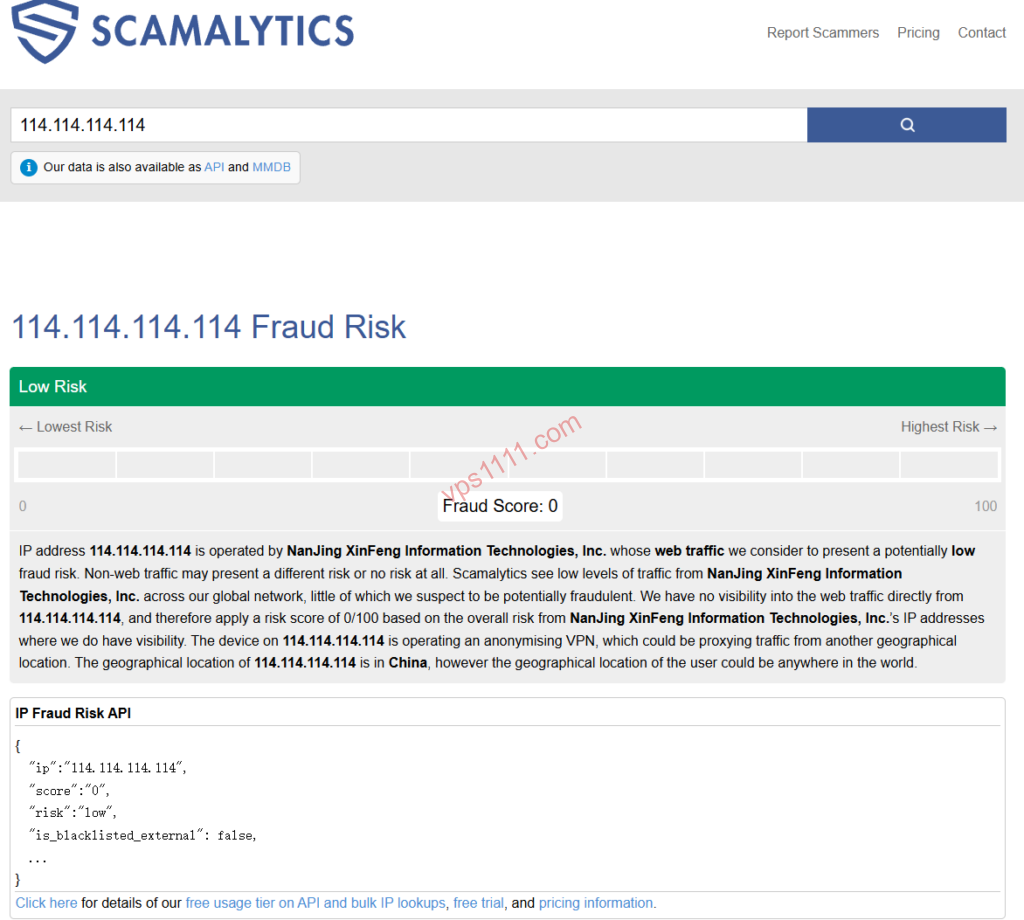
- Multi-Protocol Leak Detection (Whoer.net / Browserleaks): A clean IP alone isn’t enough. You must ensure the node’s DNS resolution doesn’t leak and that WebRTC doesn’t expose your true local IP. Focus on the “Anonymity” score, which should ideally hit 100. Pay special attention to DNS and WebRTC leaks, the two most common failure points.
Advanced Environment Optimization & Pitfall Avoidance
While residential IPs are powerful tools for preventing bans, the complex commercial landscape of 2026 still hides numerous pitfalls. As a veteran practitioner, I must objectively highlight several critical pain points:
💡 vps1111 Pitfall Avoidance & Field Guide:
- Beware of “Spoofed” Residential IPs: Unscrupulous vendors often manipulate WHOIS records or use IP broadcasting techniques to repackage standard datacenter IPs as residential ones. These instantly fail under deep risk-control scrutiny. Always cross-verify historical abuse records via Scamalytics.
- Performance vs. Latency Trade-offs: Genuine ISP residential IPs route through civilian broadband backbones. Their intercontinental routing is typically less optimized than premium commercial datacenter routes like Cogent AS174 or NTT AS2914. Consequently, when remotely managing storefronts via residential IPs, you may experience noticeable latency or packet loss. This is the unavoidable “performance tax” paid for “purity”.
- Recommendation Rating: ⭐⭐⭐⭐⭐ (For cross-border e-commerce ban prevention, this is an irreplaceable lifeline infrastructure).
Only by pairing high-purity residential IPs with clean, anti-association browser fingerprint environments (like AdsPower or Multilogin) can you build a truly impenetrable security perimeter for cross-border e-commerce.
FAQ: Common Questions Answered
Are Hosting IPs Completely Useless for Cross-Border E-commerce?
Not entirely. It strictly depends on the “use case.” For scenarios that don’t involve financial transactions or strict identity verification—such as using Python scrapers to collect public sales data, deploying backend API microservice clusters, or running self-hosted DTC e-commerce site backend services—datacenter IPs remain the optimal choice due to their massive bandwidth and low cost. Hosting IPs are only blacklisted when used for “front-end account registration and daily login as a buyer or seller.”
My IP Fraud Score is 0, So Why Was My Storefront Still Banned?
Risk control is a multi-dimensional scoring system. Even with a pristine IP, if your browser fingerprint (system language, timezone) shows logical conflicts, or if your DNS configuration leaks queries to foreign DNS servers, anti-fraud alarms will still trigger. The IP is just the foundation; overall environmental consistency is the core of ban prevention. Quick optimizations include: setting your OS language and timezone to the target region, configuring local public DNS resolvers (e.g., Cloudflare 1.1.1.1 for UK/US targets), and using professional fingerprint browsers (like AdsPower or Multilogin) to strictly isolate each account’s environment.
What If My Residential IP Gets Flagged by the Platform?
If you discover your IP has been flagged, the safest action is to contact your provider and provision a completely new IP subnet. Never use a flagged IP to log into new accounts, as it will trigger association bans. Additionally, isolate and audit all legacy accounts previously tied to that IP to prevent cross-contamination of your clean assets.
What’s the Difference Between Rotating Residential Proxies and Dedicated Dual-ISP Residential VPS?
Rotating Residential Proxies form a network by embedding SDKs into consumer devices or routers, randomly swapping IPs with every request. They are ideal for bulk registrations and scraping, but highly unsuitable for long-term storefront management, as frequent IP jumps instantly trigger cross-region login protections and risk flags.
Dedicated Dual-ISP Residential VPS statically binds a fixed, genuine residential IP to a cloud server. It combines the high trust level of home broadband with a static, unchanging IP address, making it the premier architectural solution for long-term, secure account farming and high-value storefront operations.