


Core Summary: In 2026, skyrocketing overseas VPS renewal prices are a common pitfall for beginners. From a senior architect’s perspective, this article deconstructs the underlying One-Time vs. Recurring discount logic in the WHMCS billing system, revealing the truth behind unilateral contract breaches driven by rising IPv4 costs. It also teaches you how to bypass affiliate marketing traps and secure server “grandfathered plans” that offer genuine long-term business value with permanent renewal pricing.
Let’s be honest: in the 2026 global VPS market, many beginners focus solely on the first-year invoice during Black Friday or major sales, only to be blindsided by massive renewal hikes in year two. A server that cost $10/year suddenly jumps to $50/year upon renewal. Seasoned sysadmins know the reality: cheap first-year pricing isn’t a technical achievement. A server that maintains low renewal rates and stable routing over time is the true “grandfathered plan” with lasting business value.
As global IPv4 exhaustion accelerates and cloud providers evolve their customer acquisition strategies, billing tactics have become increasingly complex. Drawing on 12 years of experience in overseas Linux operations and infrastructure architecture, I will break down the real reasons behind VPS renewal price hikes from the perspective of WHMCS billing logic and IPv4 cost structures. You will learn how to leverage industry knowledge to bypass marketing traps and lock into genuine “Recurring Discount” instances.
🧠 Breaking Down the Pricing Model: Why Do VPS Renewal Costs Suddenly Spike?
When webmasters receive steep renewal invoices, their first instinct is often to accuse the provider of price gouging loyal customers. In reality, all billing rules are explicitly outlined in the Terms of Service (TOS). From a system architecture standpoint, renewal price hikes are typically triggered by three mechanisms:
1. The Core Logic of the WHMCS Billing System: One-Time vs. Recurring
Most mid-tier and boutique VPS providers globally rely on WHMCS for billing and service management. When you apply a steep “80% OFF” promo code at checkout, you must scrutinize the underlying system parameters:
- One-Time Discount: In the WHMCS backend, this promo code only applies to the initial invoice. Once the first-year payment clears, the system automatically pulls the product’s base price from the database when generating the next year’s invoice via a scheduled Cron Job. This is a classic customer acquisition tactic.
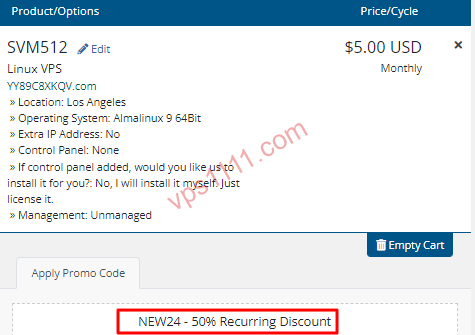
- Recurring Discount: This is the target for any long-term infrastructure. These promo codes permanently bind the discount rate to your service cycle. As long as you maintain continuous renewals, WHMCS will automatically calculate and apply the discount to every generated invoice.
2. Auto-Renewal Triggers and “Scheduled Task Downgrades”
Major cloud providers (e.g., Vultr, DigitalOcean) frequently use “$100 in free credits for new sign-ups” as an acquisition hook. Once the initial credit pool is exhausted, the system automatically charges the full standard rate to your linked credit card.
Furthermore, with budget VPS providers, even if you applied a Recurring promo code, a failed auto-charge (due to an expired card or insufficient funds) can trigger a penalty. When the invoice status shifts to Overdue, strict financial systems will often automatically strip the attached promo code during retry attempts or manual regeneration, forcing you to renew at the full base price.
3. IPv4 Cost Inflation and Unilateral Breaches by Boutique Hosts
By 2026, global IPv4 address exhaustion has reached critical levels. At regional internet registries like ARIN and RIPE, the monthly leasing cost for a single /24 subnet has surged from roughly $50 a few years ago to $150 or more.
⚠️ Industry Reality: Established, reputable providers like BandwagonHost adhere strictly to contractual obligations. Even when upstream IP costs spike, they honor the original renewal pricing for existing customers (a true Grandfathered strategy), applying price increases only to new purchases.
Conversely, if you purchase from a solo-operator host lacking its own AS number and prone to sudden shutdowns, they will often unilaterally hike renewal prices for existing users by modifying the TOS to offset unsustainable upstream costs. In these scenarios, preserving your original purchase price snapshot and TOS screenshots, then filing a PayPal Dispute, is your only viable recourse.
🛡️ Eliminating Information Asymmetry: How to Secure Genuine “Permanent Discounts” and Grandfathered Plans?
Now that we understand the underlying billing architecture, how do we counter these tactics in 2026 and identify servers truly worth retaining long-term?
1. Beware of Affiliate Marketing Traps
Many beginners blindly follow personal review blogs when purchasing infrastructure. Crucially, most review links are embedded with affiliate tracking parameters. To maximize high-yield CPA commissions on initial purchases, some affiliates deliberately obscure the “One-Time Discount” reality and aggressively push models that will see massive price hikes in year two.
Architect’s Recommendation: While benchmark data is useful, you must personally verify the presence of a Recurring tag in the Order Summary before finalizing checkout. The most reliable source for authentic promotional intelligence remains the provider’s official mailing list or technical community channels.
2. What Defines a Truly Valuable “Grandfathered Plan”?
Not every budget server warrants long-term retention. The core value lies in irreplaceable underlying network assets:
- Legacy Premium Routing: Instances featuring optimized return paths via AS1299, native IPs, and ample bandwidth. This network architecture delivers exceptional stability for global e-commerce data transit and compliant overseas deployments. Providers will find it nearly impossible to replicate this pricing tier later due to escalating upstream costs.
- ⚠️ Critical Blind Spot: The Fraud Detection Red Line for Secondary Markets! Many articles mislead beginners into “buying at a premium” from secondary forums. The reality: 99% of legitimate VPS providers explicitly prohibit account transfers and sales in their TOS. Once a provider’s fraud detection system flags cross-border IP anomalies or forced payment method changes, it will immediately trigger security protocols, resulting in permanent account suspension and complete data wipe. To secure premium infrastructure, monitor official restocks exclusively and never cross the secondary market red line.
💰 2026 Verified Recurring Discount VPS List (Stable Renewal Pricing)
To help you bypass the “One-Time Discount” system traps, I have compiled a list of stable configurations where the underlying billing system is explicitly configured for consistent renewal pricing (Recurring):
(Note: Prices listed reflect historical recurring discounts during major sales events. Please verify current stock and live pricing via the official links.)
💡 vps1111 Senior Sysadmin’s Operations & Pitfall Avoidance Guide
Securing a high-value server is only step one. To reliably maintain your “permanent discount” over the next 3–5 years, you must also navigate several hidden operational thresholds set by providers.
💡 vps1111 Configuration & Risk Mitigation Guide:
- Strict Resource Boundary Planning: For hosting static sites or lightweight monitoring probes, a 1-Core/1GB configuration is sufficient. However, if you are deploying dynamic applications with MySQL/Redis, you must start at a minimum of 2-Core/2GB. Otherwise, you will frequently trigger Linux OOM (Out of Memory) process kills, causing database crashes and downtime.
- Preventing Service Interruption & Instance Termination: The system condition for permanent discounts is “continuous validity.” If you miss a renewal and the instance is destroyed and released by the system, customer support cannot restore the original pricing at the database level. The most reliable operational practice is to pre-load a small balance (Add Funds) in your provider dashboard, allowing the billing system to prioritize auto-deductions from your account balance.
- Monitor Underlying Architecture Migration Risks: The core premise of a recurring discount is “continued official support for the host node’s underlying architecture.” If a provider announces a virtualization stack upgrade (e.g., forcibly deprecating legacy OpenVZ and migrating entirely to KVM), legacy plans will likely be forced into conversion, which typically invalidates the original recurring discount logic. Upon receiving major system maintenance notices, always back up critical data immediately.
❓ FAQ: High-Frequency Questions on VPS Renewals & Procurement (Featured Snippets)
Q1: My VPS renewal price increased. Can I submit a support ticket to request the original rate?
A: Highly unlikely. If the generated invoice shows the base price, you originally used a One-Time promo code. Overseas providers’ financial workflows are fully automated via WHMCS, and frontline support staff typically lack the permissions to manually override billing cycles or recurring logic. The optimal solution is to wait for the next major sale, purchase a new instance with a Recurring discount, and migrate your data.
Q2: If my linked credit card expires and the VPS charge fails, will the server be deleted immediately?
A: Reputable enterprise cloud providers (e.g., Linode, DigitalOcean) typically offer a 3 to 7-day Grace Period, during which services are suspended but disk data is preserved. However, certain budget promotional instances will be automatically formatted and released to other buyers if overdue by more than 24 hours. Therefore, it is highly recommended to link a PayPal auto-subscription or maintain a sufficient account balance.
Q3: Why do major cloud providers (e.g., AWS, GCP) rarely offer recurring discount codes?
A: Tier-1 cloud providers target enterprise clients, not price-sensitive individual developers. They command premium pricing through highly available ecosystem matrices and strict SLAs (Service Level Agreements). Their business model does not rely on simple “discount promotions” to lower Customer Acquisition Costs (CAC). If you require enterprise-grade high availability and have the budget, pay-as-you-go pricing from major providers remains the standard.
Conclusion
When selecting servers in 2026, eliminating information asymmetry and deeply understanding the provider’s underlying financial architecture is the core competency for reducing long-term operational costs. Steer clear of unrealistic “ultra-low acquisition pricing” traps, strictly verify the Recurring tag before checkout, and firmly reject high-risk secondary account transactions.
Plan your resources strategically, retaining only premium instances that maintain stable renewal pricing, offer reliable network routing, and remain fully under your control. By converting every IT budget allocation into solid underlying infrastructure, your global expansion strategy will remain stable and sustainable for the long haul.