


Executive Summary: In 2026, blindly ordering a “US West Coast” VPS without understanding routing will likely lead to severe performance bottlenecks. Tailored for DTC e-commerce operators, cross-border merchants, and Linux sysadmins, this guide breaks down the physical latency limits of the three core West Coast data centers (Los Angeles, Seattle, San Jose) and rigorously compares the prime time performance of major return paths like CN2 GIA, AS9929, and AS4837. Bottom line: For web hosting, prioritize LA/San Jose CN2 GIA. For high-bandwidth downloads, choose Seattle AS4837. Avoid cheap, fly-by-night hosts that hide suboptimal routing behind low prices.
Let’s be direct: in 2026, if you don’t understand the critical link between physical distance and direct peering, you’re likely falling for a complete rip-off. Many beginners see “Los Angeles High Bandwidth” in a product title and buy on impulse. Then, during prime time, they discover the return path detours through Europe or South America. Ping latency spikes past 300ms, making even basic SSH commands frustratingly sluggish.
Geography dictates the absolute floor for latency, while direct return peering determines your actual performance ceiling. Why do senior engineers and enterprise users consistently target the US West Coast? Because it hosts the primary landing stations for trans-Pacific submarine cables, offering the most efficient physical bridge between Asia and North America. Today, vps1111 breaks down the underlying network architecture of the West Coast to help you avoid overhyped, heavily oversold data centers.
The Physics of Latency: Fiber Distance and the 120ms Hard Limit
In network engineering, data packets don’t travel in perfect straight lines through submarine cables. They are constrained by the physical routing of the cables and signal degradation at intermediate nodes. Here’s a fundamental physical reality you must accept:
- Theoretical Limit: Light travels through fiber optic glass at roughly 2/3 the speed of light in a vacuum. The straight-line distance from Beijing/Shanghai to Los Angeles is approximately 10,000 km. Under perfect conditions, the round-trip physical latency (Ping) floor is 110ms – 120ms.
- Real-World Performance: Using premium direct backbones (like China Telecom CN2 GIA / China Unicom AS9929), real-world latency typically lands in the 130ms – 160ms tier. High-bandwidth optimized routes (like China Unicom AS4837 / China Mobile CMIN2) usually measure 160ms – 190ms.
- The US East Coast Reality Check: If you mistakenly choose a New York or Chicago data center, packets must traverse the entire North American continent, adding roughly 4,500 km. Direct latency jumps to 220ms – 250ms. If the return path detours, latency exceeds 350ms, instantly turning a “productivity tool” into an idle server.
The West Coast Triad: A Realistic Breakdown of Los Angeles, Seattle, and San Jose
Not all West Coast cities are created equal. The following three hubs handle over 95% of cross-border data traffic between Asia and North America.
1. Los Angeles (LA) — The Core Submarine Cable Hub and DDoS Mitigation Stronghold
Los Angeles is home to the globally renowned One Wilshire data center, the primary landing station for active trans-Pacific cables like FASTER, Unity, NCP, and JUPITER (note: the legacy TPE cable officially retired in 2024).
- Core Advantage: This is the largest aggregation point for CN2 GIA (AS4809), offering the most robust routing strategies for Asia-Pacific traffic in the US. It also hosts premium DDoS-mitigated facilities like CeraNetworks (Cera), capable of absorbing hundreds of Gbps during attacks.
- Notable Providers: BandwagonHost, DMIT, and RackNerd (LA DC02).
2. Seattle (SEA) — The High-Value Hub for Unicom Users
Located in Washington State, Seattle leverages the Westin Building Exchange. Its geographic position aligns closely with northern trans-Pacific routes, making it exceptionally friendly for China Unicom routing.
- Core Advantage: The AS4837 (China Unicom 169 backbone optimization) route combined with Seattle’s geography delivers outstanding latency and packet loss performance during prime time. It’s also the home turf of renowned DDoS protection provider SpartanHost.
- Expert Verdict: If your workload demands “1Gbps+ bandwidth + free DDoS protection + exceptional value,” and your primary audience uses Unicom or Telecom, Seattle is the definitive choice.
3. San Jose (SJ) — The Developer’s Direct Silicon Valley Gateway
As the heart of Silicon Valley, San Jose boasts massive local peering capabilities, particularly through the Equinix SV series data centers.
- Core Advantage: San Jose facilities maintain millisecond-level, LAN-like interconnectivity with tech giants like GitHub, AWS, Google Cloud, and Cloudflare. For developers frequently pulling repositories, calling overseas AI APIs, or conducting cross-border data scraping, network efficiency here far surpasses Los Angeles.
- Notable Providers: Vultr, DigitalOcean, and Oracle Cloud (San Jose/Phoenix regions).
The Routing Matrix: 2026 West Coast Network Quality Tier List
Focusing solely on the city is a common beginner mistake when choosing a West Coast VPS. What truly dictates performance is the AS Number (Autonomous System Number) assigned to the server. Regardless of the outbound route, a robust return path guarantees a solid user experience.
vps1111 Warning: In 2026, the China Telecom 163 backbone (AS4134) isn’t entirely obsolete. Some reputable providers implement advanced routing optimizations at the exit (e.g., direct submarine cable access). Paired with the BBR congestion control algorithm, it can still saturate bandwidth during prime time. However, lacking QoS priority guarantees, it is strictly unsuitable for latency-sensitive APIs or mission-critical web hosting.
Red Flags: How to Spot “Fake Direct Routing” Scams
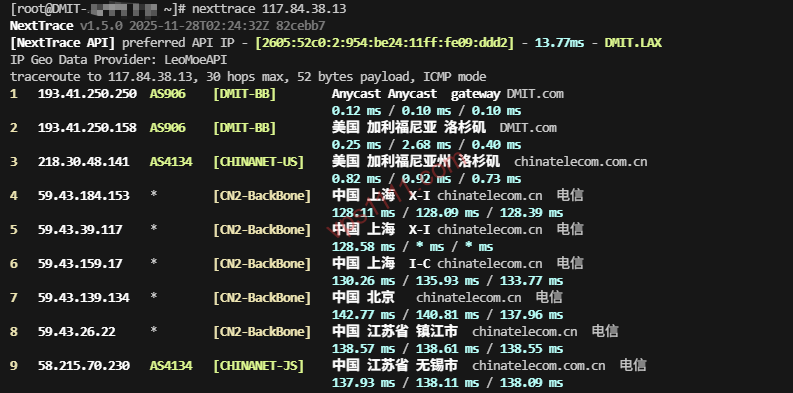
Due to high profit margins, West Coast data centers are a prime target for fly-by-night hosts. Before purchasing, always test the return path using tools like nexttrace or MTR. Watch out for these two common traps:
- CN2 GT Masquerading as CN2 GIA: Many dishonest vendors claim CN2 routing, but only use AS4809 for a few outbound hops before dumping traffic onto the congested 163 backbone once it leaves the US. True CN2 GIA requires a seamless, end-to-end AS4809 return path all the way to provincial nodes.
- Dynamic BGP Hijacking (Bait-and-Switch): The test IP shows direct routing, but after purchase, around 8 PM, the provider automatically reroutes traffic to cheaper, suboptimal transcontinental paths (e.g., outbound via Japan, return via Europe) to save on premium bandwidth costs. If you encounter this, immediately submit a support ticket for a refund.
Why the US West Coast Remains the Ultimate Value Proposition
Many ask: why not just buy a Hong Kong or Japan server? Compared to Asian nodes, the West Coast’s advantage lies in massive infrastructure redundancy driven by intense market competition:
- The Price-to-Bandwidth Gap: While premium direct bandwidth in Asia (e.g., HK CN2 GIA) offers ultra-low latency (30–50ms), it’s prohibitively expensive, typically capped at 5–10 Mbps. On the West Coast, the same budget easily secures 1Gbps or even 10Gbps ports via AS4837.
- Full-Spectrum Workload Support: The West Coast market simultaneously offers ultra-low-cost entry-level servers (Seattle 4837), heavy-duty DDoS mitigation (LA Cera), and top-tier enterprise stability (LA/SJ GIA). This level of resource resilience is impossible to match in densely populated Asian markets.
2026 Purchasing Guide: Match Your Local ISP to the Right Route
Blindly following trends is a critical mistake. The golden rule for buying a West Coast VPS is simple: match your local ISP to the route specifically optimized for it.
- China Telecom Users: If budget allows, prioritize LA CN2 GIA (AS4809) or AS9929. For tighter budgets, opt for a standard 163 route with outbound optimization, and place Cloudflare CDN in front to mask the origin IP and accelerate edge delivery.
- China Unicom Users: Buying Seattle or LA AS4837 optimized servers is a no-brainer. Unicom holds a natural international exit advantage on this route, delivering rock-solid prime time performance and unbeatable value.
- China Mobile Users: Focus on LA facilities that integrate China Mobile CMIN2 (AS58807) or CMI (AS58453). Always verify bidirectional direct routing (outbound + return) using diagnostic tools. Once confirmed, Mobile’s high-bandwidth throughput will exceed expectations.
Frequently Asked Questions (FAQ)
Q1: Should I choose LA CN2 GIA or San Jose AS9929 for web hosting?
Expert Answer: Both rank in the top tier for packet loss and latency during prime time. If your primary audience spans major Chinese ISPs, CN2 GIA offers slightly better cross-network interoperability. If your workload frequently interacts with overseas APIs (e.g., Google Cloud), San Jose’s AS9929 provides faster internal routing and DNS resolution.
Q2: Why does my West Coast server ping at only 150ms, but download speeds are slow?
Expert Answer: Low ping only confirms ICMP routing is clear; it doesn’t guarantee sufficient TCP bandwidth. Slow downloads usually stem from severe overselling on the host node’s uplink, or because your Linux kernel lacks the BBR congestion control algorithm. We recommend checking the return path for packet loss.
Q3: Is Seattle better than Los Angeles?
Expert Answer: Neither is universally better; it depends on your requirements. Seattle’s northern location hosts more DDoS-mitigated facilities and focuses on highly cost-effective AS4837 bandwidth. Los Angeles is the network core, offering the widest variety of premium routes, but at a higher price point.
💡 vps1111 Practical Guide & Pitfall Avoidance:
- Core Principle: Geography sets the physical floor; return routing sets the performance ceiling. Avoid any West Coast “fly-by-night host” that detours through Europe or third-party APAC nodes.
- Selection Matrix: For commercial web hosting and lean API development, stick to LA/San Jose CN2 GIA/AS9929. For high-bandwidth scraping and DDoS protection, target Seattle/LA AS4837.
- Recommendation Rating: ⭐⭐⭐⭐⭐ (Understanding West Coast data center topology is a mandatory step to graduate from beginner status and start architecting globally resilient infrastructure.)