


📌 Summary (Meta Description)
2026 Webmaster Essential: A deep dive into Cloudflare Cache Rules for forced caching and WAF surgical defense logic. Demystifying the true nature of Anycast BGP routing, with a step-by-step guide to authorizing premium IPs via Cloudflare for SaaS while avoiding Flexible SSL redirect loops. Includes Argo tuning strategies for standard transit routes, cutting through cloud-gamer myths to master the most hardcore CDN architecture optimizations of 2026.
Introduction: In 2026, Cloudflare Is Your Overwhelming Advantage
Let’s be honest: if you’re still exposing your VPS public IP directly to the internet in 2026, you’re not just burning through bandwidth—you’re handing a loaded weapon to DDoS attackers.
In an era where IPv4 addresses are financial assets and AI crawlers roam everywhere, Cloudflare (CF) is no longer just an “accelerator.” It’s a logical security shell. Configured correctly, it can make a $10/year idle server perform like a premium low-latency route. Misconfigured, it becomes a “decelerator” that spikes your TTFB to 2 seconds and forces legitimate users through endless verification checkpoints.
DNS & Proxy—Correcting the “Orange Cloud” Misconception
1. The Truth About Anycast BGP Routing
Many bloggers claim CF “assigns” you a node. This is a fundamental misunderstanding.
- Core Logic: CF uses Anycast technology, broadcasting the same IP across hundreds of global nodes simultaneously. Which node you hit depends 100% on your local ISP’s BGP routing policies.
- Industry Reality: Why does traffic slow down when routed through standard ISP backbones (e.g., Cogent AS174) behind CF? Because your ISP routes traffic through the cheapest peering exchange (NAP) to the nearest edge. The bottleneck isn’t CF; it’s the ISP’s transit settlement strategy.
2. Proxy Port “No-Go” Zones
Stop believing the myth that “enabling the orange cloud breaks SSH.”
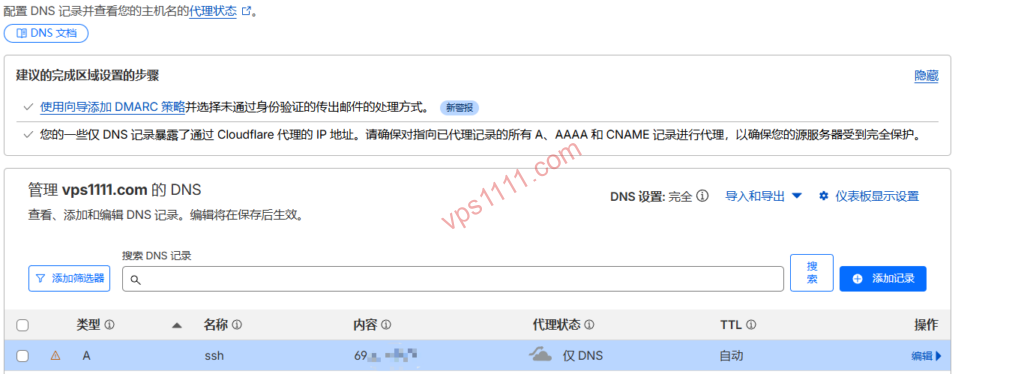
- Fact: CF’s standard proxy mode only handles specific web ports (80, 443, etc.). For SSH (22) or databases (3306), standard proxy mode is unsupported across all plans.
- vps1111 Pitfall Guide: If you need port 22 behind the proxy, you must purchase Spectrum. For most users, create a separate A record (e.g.,
ssh.vps1111.com) and keep the cloud gray for direct origin access.
Module 2: SSL/TLS—Avoiding the “Redirect Loop” Trap
1. The Deadly “Flexible” Mode
This is the most common beginner mistake and the primary cause of 520 errors.
- Failure Mechanism: In “Flexible” mode, CF connects to the origin over HTTP (port 80). If your origin Nginx enforces an HTTPS redirect, CF sends an HTTP request, the origin replies with a 301, CF sends another HTTP request, and you hit an infinite redirect loop (ERR_TOO_MANY_REDIRECTS).
- vps1111 Recommendation: Always select “Full (Strict)” mode. Even with a self-signed origin certificate, end-to-end encryption is mandatory.
Module 3: CDN Performance Optimization—Deep Dive into Cache Rules
In 2026, Page Rules are obsolete. Cache Rules are the precision tool you actually need.
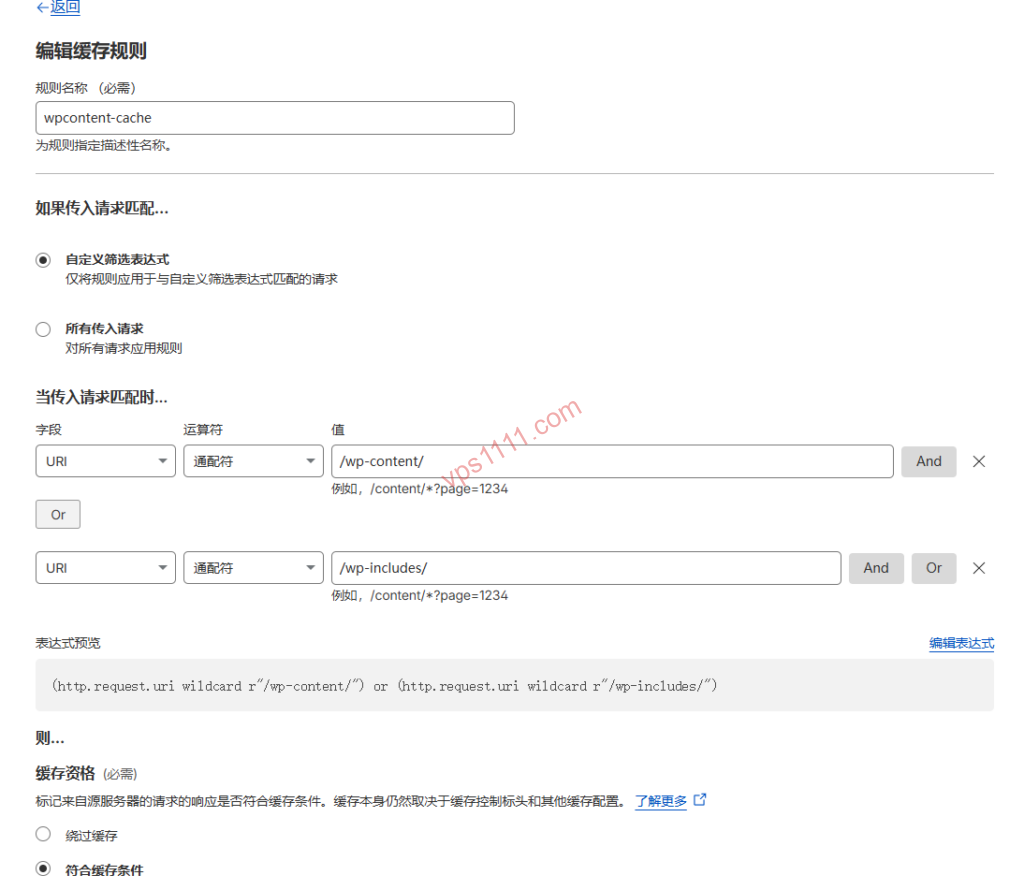
1. Forced Edge Caching Configuration Table (Based on vps1111 SOP)
| Configuration | Recommended Setting | Core Logic |
| Match Condition | URI Path contains "/wp-content/" | Targets static asset directories |
| Edge Cache TTL | 7 Days | Keeps resources at edge nodes, reducing origin fetches |
| Ignore Origin Cache Headers | Must Enable | Overrides incorrect Cache-Control directives from origin Nginx |
| Cache Key | Include Query String | Ensures parameterized requests hit the cache accurately |
2. Argo Smart Routing: The Intercontinental “Fast Lane”
If your origin is hosted on German Hetzner or US Spartan, enabling Argo significantly reduces 522 error rates.
- Mechanism: Argo probes real-time latency between CF’s global nodes. If a primary transit route congests, it dynamically reroutes via alternative peering paths. Real-world tests show a 30% drop in peak-hour packet loss.
Module 4: Defense Configuration—Precision WAF Strategies
1. Rejecting “One-Size-Fits-All” Blocks on Standard Transit
Expert Warning: Never apply blanket CAPTCHA challenges to entire ISP backbones (e.g., Cogent AS174 or HE AS6939) based on outdated tutorials!
- Consequence: Major transit providers serve millions of legitimate users. Blocking them forces every visitor through verification checkpoints, instantly destroying your SEO rankings.
2. 2026 WAF Golden Defense Script (Modular)
- Rule 1: Rate Limiting
- Logic: For
/wp-login.phpor/api/, trigger a Managed Challenge if requests exceed 5 within 10 seconds.
- Logic: For
- Rule 2: Threat Score Filtering
- Logic:
Threat Score > 10. CF maintains a global threat intelligence database; high-scoring IPs are automatically challenged.
- Logic:
- Rule 3: Bot Mitigation
- Logic: Enable “Bot Fight Mode.” In the AI era, protecting your content from unauthorized scraping is critical for maintaining original content authority.
Module 5: Advanced Tactics—Premium IPs & Cloudflare for SaaS
1. The Fatal Prerequisite for Premium IPs: SaaS Authorization
Many users point their domain’s A record directly to a CF premium IP, only to get a 403 error.
- Reality: CF edge nodes don’t recognize your domain. You must complete CNAME validation and TXT authorization via Cloudflare for SaaS (Custom Hostnames).
- vps1111 Implementation Flow:
- Host a secondary domain (Domain B) on CF.
- Add Domain A as a custom hostname under Domain B.
- Configure Domain A on a third-party DNS provider (e.g., AWS Route 53) to route to the optimized IP based on latency tests.
- Result: Bypasses congested Anycast segments while retaining CF’s WAF protection.
Module 6: Origin Tuning—BBR3 & WARP Egress
1. Correctly Enabling BBR3 (bbr3)
In IPv6 environments, differences in Path MTU Discovery can cause traditional congestion algorithms to underperform.
- Verification: Run
sysctl net.ipv4.tcp_available_congestion_control. You must seebbr3in the output. - Prerequisite Parameter: You must first set
net.ipv4.tcp_bbr3_enable=1, otherwise enabling it directly will fail and fallback to cubic. (Note: This parameter primarily applies to third-party compiled kernels like XanMod; if using an official mainline kernel with native BBR support, standard BBR activation is sufficient. Forcing this parameter may cause errors.)
2. The Lifeline for IPv6-only Servers
If your VPS only has IPv6 (common with certain grandfathered plans), it cannot natively fetch IPv4 resources.
- Action: Install the WARP client to act as an egress NAT.
- Logic: Server -> WARP -> Internet IPv4. This is the reverse direction of CF CDN origin fetches; don’t confuse them.
Quick Troubleshooting Reference Table (2026 Edition)
| Error Code | Root Cause | vps1111 Quick Fix |
| 521 | Origin firewall blocking | Check cPanel/UFW and explicitly allow official CF IP ranges. |
| 522 | Connection timeout | Routing failure or origin downtime. Enable Argo or verify service status. |
| 524 | PHP/Database timeout | Check slow queries. CF defaults to a 100-second wait before dropping the connection. |
| ERR_TOO_MANY_REDIRECTS | Incorrect SSL mode | Immediately switch SSL to “Full (Strict)”. |
Conclusion: vps1111 Pitfall Guide
“Cloudflare isn’t a magic pill; it’s a webmaster’s scalpel.”
- Don’t blindly chase premium IPs: Without SaaS validation, pointing directly to them guarantees a 403.
- Cache Rules are the core: Combined with “Ignore Origin Headers,” they can drastically improve your TTFB.
- Don’t over-block with WAF: Rate Limiting is far more effective and scientific than geographic blocking.
Bottom Line: In an era of IPv4 exhaustion and frequent AI-driven attacks, mastering Cloudflare configuration is a survival skill. Armed with this 2026 definitive guide, your server won’t just gain an “iron dome”—it will achieve accelerated performance across the global network.
📋 Dedicated Optimization Blueprint
Hardcore Recommendation
| Configuration | Recommended Value | Key Impact |
|---|---|---|
| SSL/TLS | Full (Strict) | Eliminates redirect loops |
| Caching | Cache Rules | 7-day edge caching |
🙋♂️ FAQ: Common Cloudflare Troubleshooting Q&A
How do I fix a Cloudflare 521 error?
The origin firewall is blocking CF’s origin fetch requests. Check your cPanel or UFW firewall and explicitly allow Cloudflare’s official IP ranges.
How do I resolve the ERR_TOO_MANY_REDIRECTS loop in Cloudflare?
This is caused by an incorrect SSL/TLS mode (typically “Flexible” enabled while the origin forces HTTPS). Immediately switch the SSL mode to “Full (Strict)”.
The edge node doesn’t recognize your domain. You must first complete CNAME validation and TXT authorization via Cloudflare for SaaS (Custom Hostnames) before using premium IP routing.